

She Brushed and Flossed Every Day. Pregnancy Gave Her Cavities Anyway.
Bleeding gums, new cavities at every checkup, and no answers. Then her father-in-law, a dentist of 40 years, told her what was really going on in her mouth.
Katherine did everything right.
She brushed twice a day. She flossed every night. She never skipped a cleaning.
Then she got pregnant, and her mouth seemed to fall apart. Her gums bled every time she brushed. And at every dentist appointment, she walked out with the same news: another cavity.
"I felt like I was being punished for something I wasn't doing wrong." -Katherine, co-founder of SuperTeeth

The pregnancy side effect nobody warns you about
If this sounds familiar, you're far from alone. Roughly 60 to 75% of pregnant women develop gingivitis, the swollen, bleeding gums that come with gum inflammation.
The culprit is hormones. As estrogen and progesterone surge, your gums become more reactive to the bacteria already living in your mouth. Add morning sickness, cravings, and exhaustion, and the balance in your mouth can tip fast.
Katherine switched toothpastes. She tried the "natural" brands. Nothing changed.
"I knew my body was trying to tell me something. I just couldn't make sense of it." - Katherine

The answer was sitting at the family dinner table
Katherine's father-in-law has been a dentist for more than 40 years. When she finally told him what was happening, his answer reframed everything.
Cavities and bleeding gums, he explained, aren't just wear and tear. They're signs of an infection in the mouth, driven by an overgrowth of the wrong bacteria.
That word stuck with her: bacteria.
Years earlier, Katherine had seen firsthand how much the good bacteria in her body mattered. A daily probiotic had helped bring her gut back into balance after a rough stretch postpartum.
"If good bacteria helped my gut, why not my mouth?"
Katherine, her husband Cameron, and his father dug into the research. They found that the mouth has its own microbiome, just as influential as the gut's. Yet almost every product on the shelf was built to wipe bacteria out, not support the good ones.
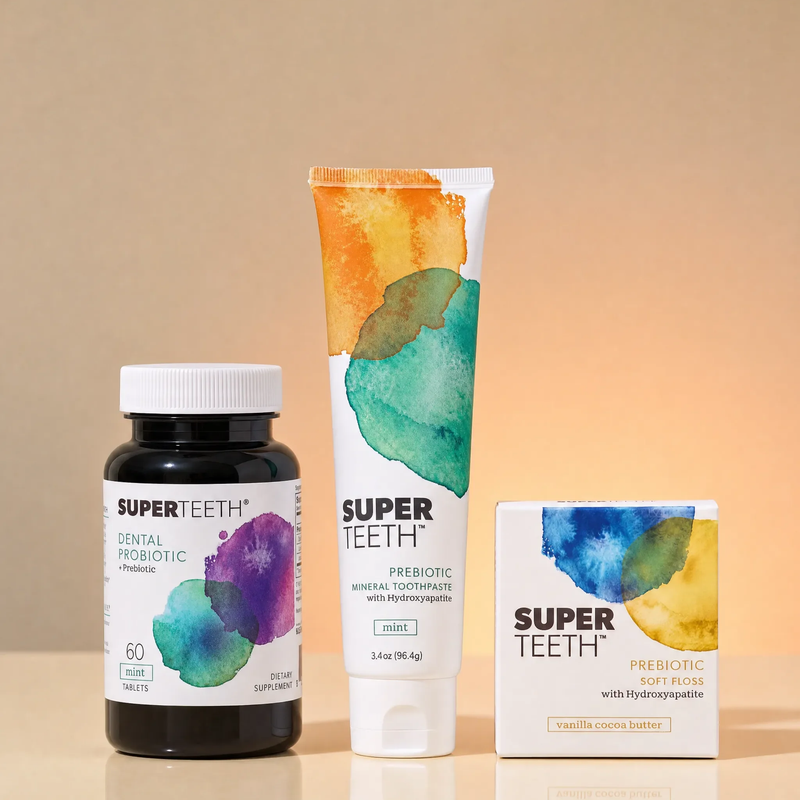
So they formulated one of the first dental probiotics, with three strains studied for oral health. Katherine made it part of her daily routine and she has been cavity-free ever since.
Her results are her own, and everyone's mouth is different. But it turned a family experiment into a mission: oral care that works with your biology, not against it.
Shop the Post


A Different Approach to Oral Health
More people are shifting toward solutions that support the body’s natural balance—rather than disrupt it.
Instead of harsh ingredients, this approach focuses on:
- Supporting beneficial bacteria
- Reducing harmful buildup over time
- Creating a healthier oral environment

Results Over Time
Healthier gums and fresher breath (1)
Better cavity protection (2) and a reduction in plaque (3)
Fewer signs of early cavities and gum swelling (4)
81% fewer cavities (5), 73% less gum inflammation (5), Stronger teeth and long-term mouth health (6) (7)
A Different Approach to Oral Health

Probiotic Oral Care Regimen
|
Other Toothpastes & Mouthwashes |
|
|---|---|---|
| Supports Oral Microbiome | ✓ | ✕ |
| Targets Bad Breath at the Source |
✓ | ✕ |
| Works While You Sleep | ✓ | ✕ |
| Breaks Down Plaque | ✓ | ✓ |
| Strengthens Teeth | ✓ | ✓ |
| Prebiotic + Probiotic Support | ✓ | ✕ |



Find What Your Mouth Actually Needs
Take our guided quiz to better understand your symptoms and find the right solution for your routine.
Related Articles

What Causes Bad Breath (And How to Fix It)
Bad breath isn’t just about hygiene—learn what actually causes it and how to fix it at the source.
Read more
The Truth About Oral Bacteria
Not all bacteria are bad. Here’s how balancing your oral microbiome can improve your oral health.
Read more
Why Mouthwash Isn’t Enough
Mouthwash may mask the problem—discover why it’s not a long-term solution for oral health.
Read more(1) Babina K et al. (2024). A Three-Month Probiotic (the Streptococcus salivarius M18 Strain) Supplementation Decreases Gingival Bleeding and Plaque Accumulation. Dentistry Journal, 12(7), 222
(2) Di Pierro F et al. (2015). Cariogram outcome after 90 days of oral treatment with Streptococcus salivarius M18 in children at high risk for dental caries. Clinical, Cosmetic and Investigational Dentistry, 7, 107–113
(3) Kiselnikova LP et al. (2022). Changes in the main dental parameters of preschoolers with caries affected by longterm probiotic intake. Pediatric Dentistry and Dental Prophylaxis, 22(2), 97–102
(4) ⁷ Tandelilin R et al. (2018). The effect of oral probiotic consumption on the caries risk factors among high-risk caries population. Journal of International Oral Health, 10(3), 132
(5) ⁴ Kiselnikova LP et al. (2022). Changes in the main dental parameters of preschoolers with caries affected by longterm probiotic intake. Pediatric Dentistry and Dental Prophylaxis, 22(2), 97–102
(6) Burton JP et al. (2013). Influence of the probiotic Streptococcus salivarius strain M18 on indices of dental health in children. Journal of Medical Microbiology
(7) Bardellini E et al. (2020). Does Streptococcus salivarius strain M18 assumption make black stains disappear in children? Oral Health and Preventive Dentistry, 18(2), 161–1